Algarve-Tourist.com
The best independent guide to the Algarve
Algarve-Tourist.com
The best independent guide to the Algarve
Algarve car rental guide - An independent guide to hiring a car in 2026
By Philip Giddings · Last updated
A rental car opens up the Algarve. With your own transport, you can reach secluded beaches, quiet villages, and scenic viewpoints that bus routes and tour operators never touch. For anyone staying in a rural hotel or travelling with young children, a car transforms the logistics of a holiday.
That said, not everyone needs one. The main resort towns are well connected by public transport, and driving brings its own complications: unfamiliar roads, aggressive local drivers, and the challenge of finding parking in busy areas during high season.
This guide covers the advantages and disadvantages of renting a car, the practicalities of booking and collection, and the common pitfalls to avoid. The final section lists the best destinations to visit with your own transport.(or jump to the section here).
Quick summary for car hire in the Algarve
A rental car makes sense if you:
• Are staying in a rural hotel or holiday home away from the main towns
• Want to explore villages and beaches off the beaten track
• Are travelling with children and need flexibility for naps, snacks, and impromptu stops
• Plan to visit the western Algarve around Sagres, where public transport is limited
A rental car may not be worth it if you:
• Are based in a major resort with beaches and restaurants within walking distance
• Prefer not to deal with unfamiliar roads, tolls, and parking
• Are under 25, as surcharges and restrictions add significantly to the cost
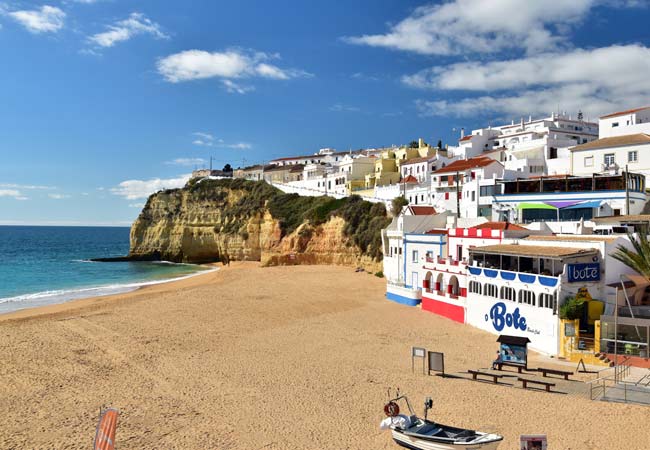
A car is essential for exploring quieter areas like Carvoeiro
Electric car rental warning
Stick with petrol or diesel. Although electric cars are increasingly common in rental fleets, they create unnecessary complications for a holiday. Charging infrastructure in the Algarve remains patchy, and time spent searching for working charge points is time not spent on the beach.
Rental companies often have a surplus of electric vehicles and may offer them at a discount or as a free upgrade. Politely decline unless you are confident navigating the charging network.
Other considerations for car rental in the Algarve
Second drivers can be added to the rental agreement but will increase the cost. Weigh whether the convenience justifies the fee, particularly for longer trips or if you plan to share the driving.
Driving to Spain requires advance notice. Standard Portuguese rental contracts do not cover cross-border travel, and additional insurance must be arranged before you leave.
Age restrictions apply to most rentals. The minimum age is typically 21, but drivers under 25 face surcharges and may be limited to certain vehicle categories. Check the specific policy before booking.
Airport collection is usually the most convenient option, allowing you to start driving immediately on arrival. However, off-airport companies sometimes offer lower rates, so compare prices before committing.
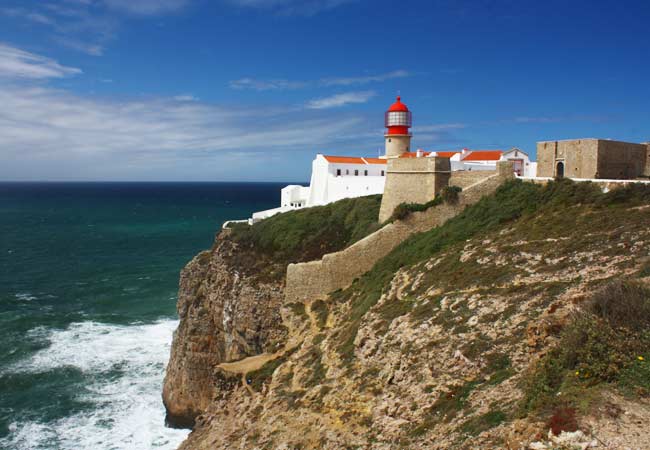
Cabo de São Vicente, at the western tip of the Algarve, requires a car to reach
Collision Damage Waiver (CDW) insurance
Most rental cars come with an excess of around €800, meaning you pay this amount towards any damage before the rental company's insurance covers the rest. A Collision Damage Waiver reduces or eliminates this excess.
Rental companies offer their own CDW when you collect the car, typically charging around €20 per day. This can easily exceed the cost of the basic rental. Declining the CDW is possible, but expect a thorough inspection of the vehicle when you return it.
Third-party CDW insurance, purchased in your home country before you travel, often costs a fraction of the rental company's price. The catch: if damage occurs, you must pay the full excess to the rental company upfront and then claim it back from your insurer after returning home. This process can take weeks and requires detailed documentation.
A credit card is essential for car hire. Rental companies will pre-authorise the excess amount on your card when you collect the vehicle. Debit cards are rarely accepted for this purpose.
Vehicle damage disputes
Disputes over vehicle damage are the most common source of car hire problems. Rental companies may charge for:
• Pre-existing scratches or dents that were not documented at collection
• Minor scuffs or stone chips classified as chargeable damage rather than normal wear
Protect yourself before driving away. Inspect the car thoroughly in good light, photograph every existing mark no matter how small, and ensure all damage is recorded on the rental paperwork. Do not let staff rush you through this process. The same employees who seem friendly at collection may scrutinise the car closely on return.
Choosing a rental company
This guide does not recommend specific car hire companies. Standards vary from year to year, and individual experiences differ widely. Some companies have particularly poor reputations, but naming them would create legal complications.
Research thoroughly before booking. Look for recent, detailed reviews from other travellers and ignore advertisements that may not reflect actual service quality.
Smaller local companies sometimes offer better service and value than the international brands. Travelrent and Drive 4 Fun both have reasonable reputations among visitors. For comparing prices and availability across multiple companies, Zest is the most reliable search platform for Portugal.
A useful Tripadvisor forum thread discusses the companies to avoid in more detail than this guide can: www.tripadvisor.co.uk/ShowTopic
Franchise brands in Portugal
Familiar rental brands often operate as franchises in Portugal, run by entirely separate companies that share only a name and logo with the parent. A good experience with Hertz or Europcar in the UK or US means nothing about the service you will receive at Faro Airport.
Always check recent reviews specific to the Portuguese operation, regardless of your history with the brand elsewhere.
Where to visit with a rental car
A rental car opens up the full length of the Algarve, from the Spanish border to the windswept cliffs of the west coast. These ten destinations reward the effort of driving.
Tavira sits in the quieter eastern Algarve, a town of cobbled streets, traditional tiled houses, and over thirty churches. The Gilão River divides the old centre, crossed by an ancient footbridge and a larger 17th-century span. South of town, ferries run to the beaches of Ilha de Tavira. The drive from the central Algarve takes around 45 minutes but feels like arriving in a different Portugal.
Sagres occupies a remote peninsula at the southwestern tip of the Algarve. Powerful Atlantic swells draw surfers, while the rugged coastline and lack of development attract visitors seeking something beyond the manicured resorts further east. The Fortaleza de Sagres stands on a headland protected by sheer cliffs on three sides. The town itself is small and low-key, its appeal lying in the surrounding landscape rather than any specific sights.
Monchique and the Algarve hills rise inland from the coast, offering cooler air and forested slopes. The N266 climbs through the spa village of Caldas de Monchique to the town of Monchique itself, then continues to the summit of Fóia (902m), the highest point in the Algarve. On a clear day, the view stretches south across the entire region to the Atlantic.
Cabo de São Vicente marks the southwestern corner of mainland Europe. Medieval sailors believed this windswept headland to be the edge of the known world. Towering cliffs drop to churning seas, and a 19th-century lighthouse stands against the constant wind. The cape lies six kilometres beyond Sagres and the two combine naturally into a single trip.
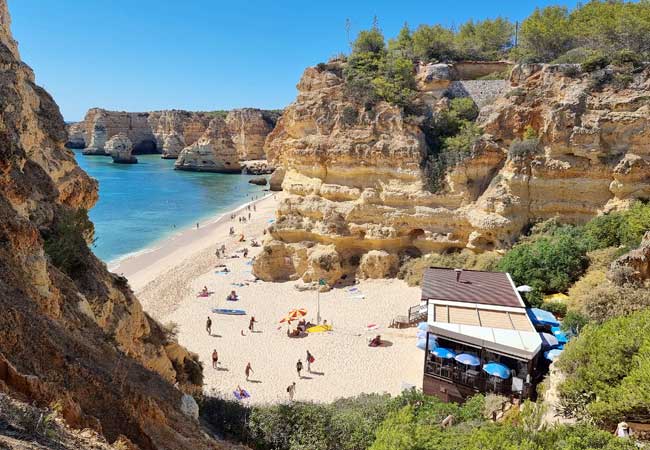
Praia da Marinha regularly appears on lists of the world's most beautiful beaches. Golden sand sits beneath weathered limestone cliffs, and a distinctive double arch rises from the shallows at the western end. The clifftop above marks the start of the Sete Vales Suspensos trail, a six-kilometre walk along one of the finest stretches of coastline in southern Europe.
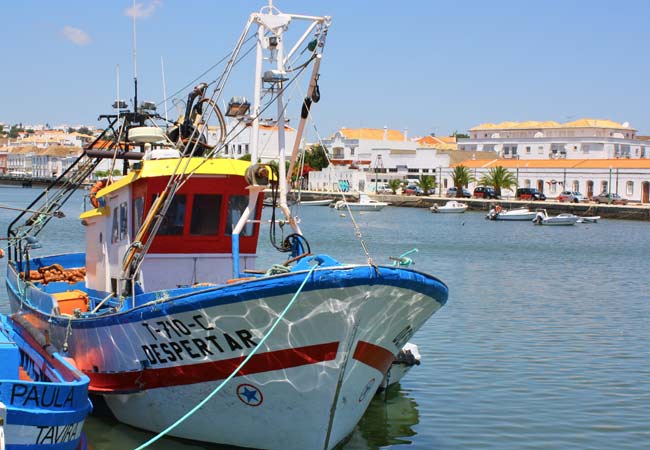
Ferragudo has escaped the development that transformed neighbouring Portimão and Praia da Rocha. Whitewashed houses climb the hillside from a working harbour where fishing boats still land the morning catch. Narrow streets lead to a small church at the top of the village, with views across the Arade estuary. Two beaches sit south of the village, both quieter than the crowded sands nearby.
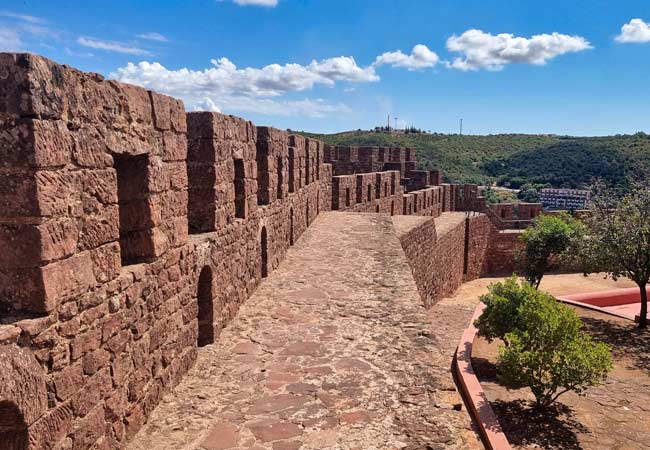
Silves served as the Moorish capital of the Algarve between the 9th and 12th centuries. A massive red-brick castle dominates the town, its walls among the best-preserved Moorish fortifications in Portugal. Below, the old centre contains a 13th-century cathedral and cobbled streets largely untouched by tourism.
Estoi lies in the hills north of Faro, combining Roman ruins with 18th-century grandeur. The remains of Milreu date from the 1st century and include well-preserved mosaics and the outline of a luxurious villa. Nearby, the Pousada Palácio de Estoi occupies a restored Rococo palace surrounded by formal gardens.
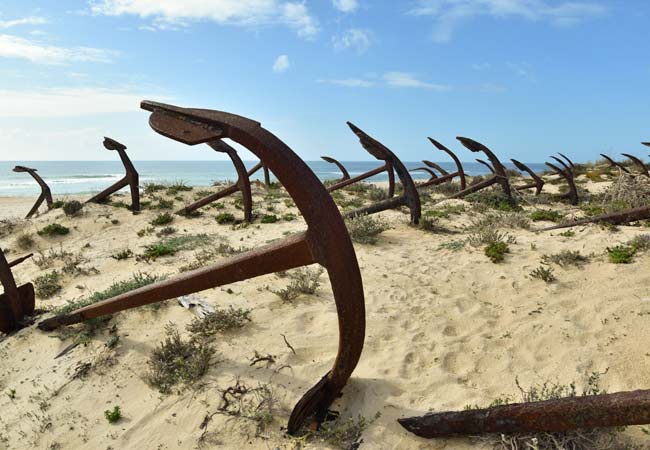
Praia do Barril offers one of the most unusual sights in the Algarve. Behind the beach, over 240 rusting anchors stand in the dunes, a memorial to the tuna fishing community that abandoned this stretch of coast in the 1960s when stocks collapsed. A miniature railway, once used to transport the catch, now carries visitors across the marshes from Santa Luzia.
Cacela Velha is a tiny whitewashed village on a clifftop overlooking the Ria Formosa lagoon. A small church and the remains of a fort frame views across to a sandbar beach and the open Atlantic beyond. The beach is reached on foot across the lagoon at low tide or by boat, adding to the sense of discovery.
Castro Marim guards the Spanish border from a hilltop above the Guadiana River. The medieval castle offers views across salt flats where Flor de Sal, a prized finishing salt, is still harvested by traditional methods. Inside the fortress walls, a small museum documents grimmer aspects of the town's history.
Mértola lies beyond the Algarve in the neighbouring Alentejo region, but rewards those willing to make the drive. This fortified village stands above a bend in the Guadiana River, its skyline dominated by a church that was once a mosque. The surrounding landscape forms part of the Parque Natural do Vale do Guadiana, wild and largely empty.
The interactive map below displays the location of these towns and attractions. (Note: zoom in or out to see them all)
Legend: 1) Tavira 2) Sagres 3) Monchique 4) Fóia hill 5) Cabo de São Vicente 6) Praia da Marinha 7) Ferragudo 8) Silves 9) Estoi 10) Praia do Barril 11) Cacela Velha 12) Castro Marim 13) Mértola
Driving practicalities
Portugal tolls
Portuguese motorways use an electronic toll system called Via Verde. When collecting your rental car, ask for a Via Verde transponder. This small device attaches to the windscreen and registers tolls automatically as you pass through gantries.
A transponder is essential rather than optional. Many motorways have no cash booths or barriers, only overhead cameras that read number plates and transponder signals. Without a transponder, you must register your vehicle online or pay at designated service stations and post offices within a set period. This is time-consuming and easy to forget, resulting in fines. visitors.viaverde.pt
For foreign-registered vehicles:
www.portugaltolls.com/
To estimate toll costs for your journey:
https://
Speed cameras are increasingly common throughout Portugal, both in towns and on major roads. Warning signs indicate camera zones, but the cameras themselves are often inconspicuous, painted neutral colours or positioned to blend into their surroundings.
Alternatives to car rental
Alternatives to Car Rental in Portugal
Public transport in the Algarve ranges from adequate to non-existent. A single railway line connects the main towns along the coast, though it bypasses much of the central tourist area. Bus services fill some gaps but run infrequently to smaller destinations.
Railway timetables: www.cp.pt.
Regional bus services: www.vamusalgarve.pt
Uber and Bolt offer a practical middle ground between public transport and car rental. Both apps operate throughout the Algarve, with fares often cheaper than expected. A trip from Albufeira to Zoomarine costs around €25; Faro Airport to Praia da Rocha around €40.
During high season, drivers can be scarce, particularly for early morning airport transfers. Download the app before you travel and check that your payment method does not incur foreign currency charges.
Our most popular guides to the Algarve


About the author: I'm Philip Giddings and have been writing these independent guides since 2009. I first visited the Algarve in 2001 when my Portuguese wife, Carla, was proud to show her country to me. We now live in Lisbon but I'm in the region most weeks researching and updating this site or visiting Carla’s extended family who live here. Having both Portuguese-family and friends who live within the Algarve gives me the local insight and personal connection to the region.
I love the Algarve region and strive to ensure every practical detail (such as ticket prices, opening hours) is correct, by checking against official sources and confirming in person on the many trips I make. I am experienced in Portuguese travel having written almost 2,000 guides for my wider set of Portugal Guides, and this is my full-time work and passion. The site is funded by affiliate commissions on tour and accommodation bookings, disclosed on every page that carries them. No tourist board, tour operator or attraction pays to appear here. My full story can be read here.