Algarve-Tourist.com
The best independent guide to the Algarve
Algarve-Tourist.com
The best independent guide to the Algarve
Planning a low-cost and budget holiday to the Algarve in 2026
The Algarve offers genuine value in a region of Europe where beach holidays have become increasingly expensive. A week here costs noticeably less than comparable Mediterranean destinations, with savings evident across accommodation, flights, restaurants, and daily spending.
The Algarve region boasts a glorious climate, stunning beaches and lively beach towns, along with the welcoming disposition of the Portuguese. For a holiday, the Algarve offers a wide variety of accommodation types to suit all budgets, while food and drink can be exceptional value. It is also served by all of the low-cost airlines, which fly into Faro airport.
This guide covers the practical ways to stretch a holiday budget further: when to travel, where to book, and how to avoid the common mistakes that quietly drain money from even careful planners.
When to visit for the best value
The timing of your holiday affects costs more than any other single decision. Accommodation prices in July and August run roughly 60 per cent higher than the low season months of November through March, with flights following a similar pattern.
June and September offer the best balance for budget-conscious travellers not tied to school holidays. Weather remains excellent, beaches are noticeably quieter than peak summer, and prices sit closer to shoulder-season rates. The sea stays warm enough for swimming well into October, particularly along the sheltered eastern coast.
For families restricted to school holidays, the maths favours Easter and the late May half-term over the summer break. A week in late May typically costs 30 to 40 per cent less than the same accommodation in August, with temperatures already reaching the mid-twenties and water parks open for the season.
The Algarve's winter draws a different crowd entirely. From November through February, retirees and remote workers take advantage of mild temperatures, empty beaches, and accommodation rates that drop to a fraction of summer prices. Daytime temperatures hover around 16 to 18°C, pleasant for walking, cycling, and golf if not for swimming.
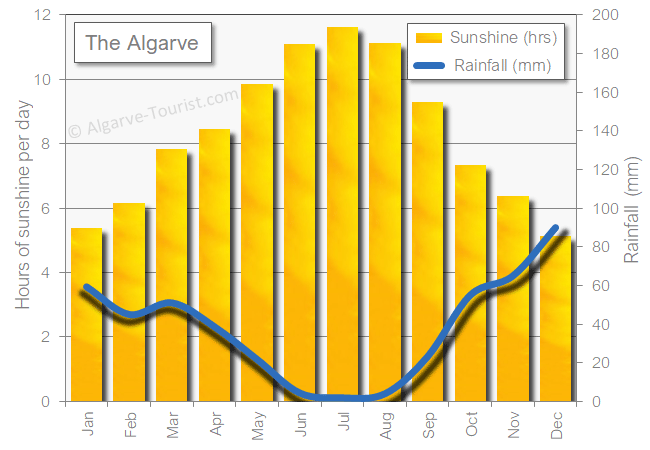
The average hours of sunshine per day and amount of rain
Booking flights and accommodation early
Flights and accommodation represent the largest share of any holiday budget, and both follow the same pricing principle: the earlier you book, the less you pay.
This applies regardless of when you travel. A July flight booked in January will cost less than the same seat purchased in May. Hotels and rental properties follow identical patterns, with the best options disappearing first and prices climbing as availability tightens.
The post-Christmas period sees a surge in summer bookings as people finalise holiday plans. Those hunting for genuine bargains book earlier still. Retirees and experienced budget travellers often reserve flights the moment airlines release their schedules, typically nine to twelve months ahead. By February, the cheapest summer options have largely gone.
A realistic approach: decide on your dates and destination, then book within the week. The price you see today will almost certainly be higher in a fortnight. Last-minute deals, once a reliable fallback, have largely vanished from the travel industry. Airlines no longer discount unsold seats close to departure, and any savings on out-of-season hotels tend to be offset by higher flight costs.
If plans remain uncertain, many hotel booking platforms allow reservations without upfront payment or with free cancellation. This lets you lock in early pricing while retaining flexibility, though read the terms carefully before assuming you can cancel without penalty.
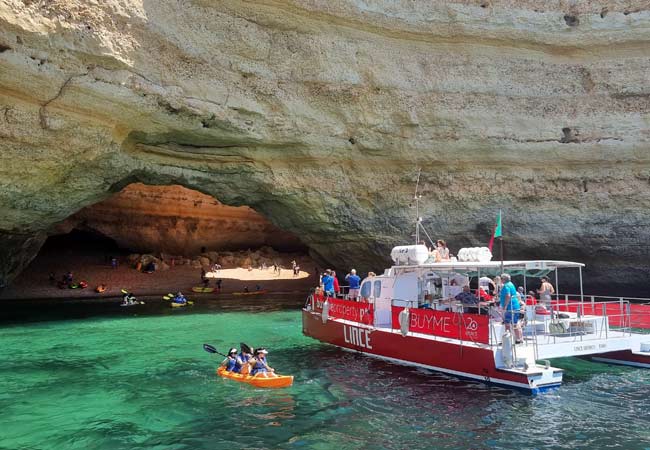
Where to stay: choosing a resort or town
The Algarve stretches 150 kilometres from the Spanish border to the windswept cliffs of Sagres, with over twenty distinct towns and villages along the way. The good news for budget travellers: once you arrive, daily costs remain remarkably consistent across the region. A meal, a drink, a boat trip, or a day at a waterpark will cost roughly the same whether you stay in Tavira or Lagos, Albufeira or Olhão.
The real price difference lies not in which town you choose, but in where you eat and drink within it. Every resort has two economies running in parallel: tourist-focused restaurants on the main strips, and local places tucked a few streets back. A seafood lunch on Albufeira's beachfront might cost twice what you'd pay at a family-run tasca ten minutes uphill. Vilamoura's marina charges premium prices; the nearby town of Quarteira serves the same fish to locals for considerably less. Choosing the right restaurants matters more than choosing the right resort.
That said, some towns make finding those local spots easier than others. The following breakdown helps narrow the options.
The Eastern Algarve: Tavira, Olhão, Cabanas
The eastern stretch feels closer to traditional Portugal. Tavira is the standout, a genuinely beautiful town of cobbled streets, tiled churches, and a hilltop castle, drawing visitors who want culture alongside their beach time. Olhão offers a working fishing port and the Algarve's best food market, though its waterfront is urban rather than picturesque. Cabanas provides a quieter village atmosphere with a long sandbar beach.
Beaches here differ from the central and western Algarve. The Ria Formosa lagoon system creates calm, shallow waters ideal for families with young children, though reaching the best sands often requires a short ferry or water taxi. The eastern towns also sit closest to Faro Airport, keeping transfer costs low.
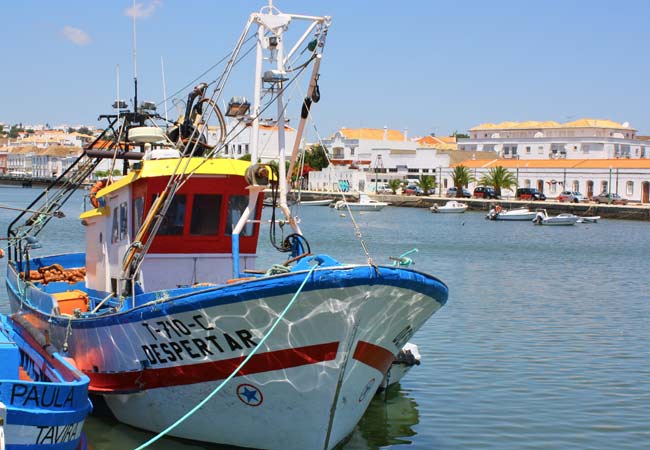
The Central Algarve: Albufeira, Vilamoura, Quarteira
The central region contains the Algarve's largest and busiest resorts. Albufeira remains the most popular destination, offering everything from a pretty old town to the notorious Strip, a neon-lit avenue of bars and clubs that draws young partygoers each summer. Vilamoura is more upmarket, built around a large marina lined with restaurants and boutiques. Quarteira, often overlooked, provides a more local feel at lower prices, with a long beach and traditional Wednesday market.
Families often choose this area for convenience. The main waterparks sit within easy reach, transfers from Faro take under thirty minutes, and the concentration of hotels means plenty of competition on price. The trade-off is a more developed, tourist-oriented atmosphere, with fewer opportunities to stumble upon authentic local life.
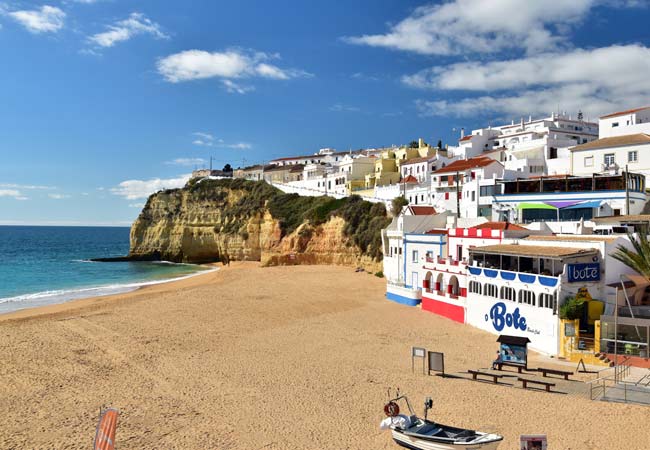
The Western Algarve: Lagos, Portimão, Praia da Rocha, Sagres
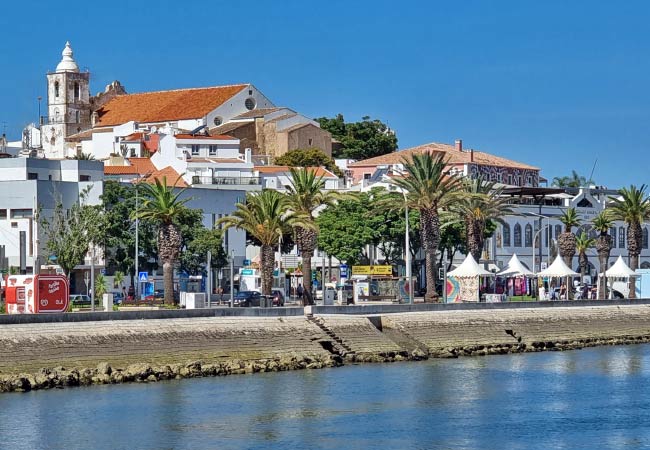
The western coast combines two distinct characters. Lagos and Praia da Rocha are lively resort towns with excellent beaches, busy bar scenes, and easy access to some of the Algarve's most dramatic coastal scenery, including the famous Ponta da Piedade cliffs. Lagos in particular balances tourism with a genuine historic centre, its old town filled with independent shops and restaurants rather than generic tourist outlets.
Further west, the pace slows considerably. Sagres attracts surfers and those seeking wilder, less developed coastline, with Atlantic swells and a laid-back atmosphere quite different from the family resorts further east. Accommodation options are more limited here, and the remote location means higher transfer costs from Faro, typically around 70 to 80 euros each way.
Practical considerations
Transfer costs from Faro Airport vary significantly by destination. The eastern towns and central resorts sit within a 30 to 40 euro range for a private transfer, while Lagos and beyond push toward 75 euros or more. For couples or solo travellers, shared transfers reduce this cost but require booking well ahead, particularly in summer when they sell out quickly.
Related articles: Where to go for a holiday in the Algarve?
Accommodation types: hotels, apartments, and villas
The choice between hotels, apartments, and villas comes down to how you want to spend your holiday rather than which option costs less. Each suits different travel styles, and the right choice depends on your priorities.
Hotels offer convenience and facilities. Someone else makes the beds, cleans the bathroom, and maintains the pool. Larger resort hotels provide kids' clubs, multiple restaurants, and organised entertainment, valuable for families wanting everything on site. The trade-off is less space, less privacy, and no option to prepare your own meals.
Self-catering apartments suit those who prefer independence. A kitchen allows you to prepare breakfast and the occasional lunch, cutting food costs significantly over a week or two. This saving proves particularly worthwhile for families, where restaurant bills for four or five people add up quickly. Apartments also provide more room to spread out, separate sleeping areas for children, and the freedom to eat when hunger strikes rather than when the hotel restaurant opens.
Rental villas make sense for larger groups and extended families. Splitting costs across two or three couples, or between grandparents and their children's families, often brings the per-person rate below hotel prices while providing far more space. A private pool means no early-morning sunbed races. However, villas frequently sit outside town centres, making a rental car or regular taxis necessary for beaches, restaurants, and supermarkets. Check the exact location before booking: a property described as "near Lagos" might be a fifteen-minute drive from anywhere useful.
Some aparthotels and hotel-apartments combine elements of both worlds, offering basic kitchen facilities alongside hotel services like reception desks and pool complexes. These can work well for families wanting self-catering flexibility without sacrificing resort amenities, though prices often reflect the hybrid offering.
All-inclusive packages exist in the Algarve but rarely represent good value. Options are limited compared to Spain or Turkey, food quality tends toward average, and the low cost of eating out locally undermines the main appeal of the format. A self-catering apartment combined with meals at local restaurants will usually cost less and deliver better food.
A useful booking strategy: many hotel platforms allow reservations without upfront payment or with free cancellation up to a certain date. Booking early at the lowest available rate, then continuing to check for better options, costs nothing if you cancel within the terms. Read the cancellation policy carefully before assuming flexibility.
A necessary warning: only ever book accommodation through reputable websites. Fraudulent listings appear periodically, particularly for villas, often with prices that look too good to be true. Never pay by direct bank transfer, as this offers no protection if the property turns out not to exist. Credit card payments and established booking platforms provide recourse if something goes wrong.
Getting the best value on flights to the Algarve
Faro Airport handles flights from across Europe, served by budget carriers and conventional airlines alike. Prices vary enormously depending on when you book, when you fly, and how carefully you avoid unnecessary charges.
The same principle that applies to accommodation applies here: book early. Flight prices climb as seats fill, and the cheapest fares disappear first. Waiting for a last-minute deal is a strategy that no longer works. Airlines would rather fly with empty seats than discount heavily before departure.
Compare all airlines before booking, not just the budget carriers. At peak travel times, particularly Friday evenings, Saturday departures, and Sunday returns, the price gap between low-cost and conventional airlines shrinks considerably. A slightly higher base fare sometimes includes luggage and seat selection that would cost extra elsewhere, making the total price competitive or even cheaper.
Hidden fees catch out careless bookers. Budget airlines price aggressively on the headline fare, then add charges for hold luggage, cabin bags, seat selection, and check-in methods. These extras can double the apparent cost of a flight if you need them all. Read the baggage allowance carefully before booking and factor in the true total.
For a summer holiday, a single 20kg or 23kg hold bag typically suffices for two adults or two children. Packing light and sharing luggage costs less than paying for multiple bags. If your airline charges steeply for hold luggage, weigh whether a different carrier with inclusive baggage works out cheaper overall.
Avoid flying into Lisbon for an Algarve holiday. The price difference rarely justifies the inconvenience: a two-and-a-half-hour train journey to Faro, followed by a further connection to your resort, adds half a day of travel each way. Private transfers from Lisbon to the Algarve cost upwards of 200 euros. Faro exists precisely to serve this coastline.
Airport transfers and getting around
Faro Airport sits on the eastern edge of the Algarve, roughly fifteen minutes from Faro itself and within an hour of most resort towns. Public transport options are limited, and the majority of visitors arrange transfers in advance.
Private transfers offer door-to-door convenience at reasonable rates if booked ahead. A transfer to Albufeira costs around €35, Vilamoura around €30, and Lagos around €75. Prices are per vehicle rather than per person, making private transfers good value for families and groups of three or four. Drivers meet you in the arrivals hall, help with luggage, and deliver you directly to your accommodation.
Shared transfers reduce costs for couples and solo travellers by splitting a minibus with other passengers heading to the same area. The trade-off is a less direct journey, with multiple hotel stops before reaching your own. Expect shared transfers to cost roughly half the private rate, though journey times stretch accordingly.
The Aerobus provides the only scheduled public transport from the airport, running to Albufeira, Lagoa, Portimão, and Lagos. The service operates from May to September with just six departures daily, limiting its usefulness for anyone arriving outside those times. Timetables appear on the Vamus Algarve website
(vamusalgarve.pt), with the airport route listed as line 56. Fares are considerably cheaper than private transfers, but the limited schedule and fixed stops mean this works only if your accommodation sits conveniently close to the route.
Getting around during your stay depends largely on where you are based. The larger resort towns are walkable, with beaches, restaurants, and shops within easy reach of most accommodation. Day trips to other towns or beaches become more complicated. Local buses connect the main resorts but run infrequently and take indirect routes. Taxis and ride-hailing work for occasional journeys but add up over a week. Hiring a car makes sense for those planning regular excursions beyond their base, though parking can prove difficult in the busier towns during summer.
Eating and drinking on a budget
Food and drink represent one of the Algarve's genuine advantages over other Mediterranean destinations.
Supermarkets and self-catering
A well-timed supermarket shop at the start of your holiday pays dividends throughout your stay. Stocking up on water, snacks, breakfast items, and alcohol avoids the steady drain of buying these at beach bars and tourist shops, where prices run two or three times higher.
Pingo Doce offers the best combination of quality and value, with stores across the region carrying fresh bread, local cheeses, Portuguese wines, and ready-made salads alongside standard groceries. Continente provides similar range in larger format stores. Lidl delivers the lowest prices on basics. Most supermarkets open early and stay open until at least 9pm, with all operating on Sundays.
Finding local restaurants
The Algarve operates two parallel restaurant economies. Beachfront terraces and marina-side tables charge tourist prices for the view. A few streets back, family-run restaurants serve the same fish to locals at considerably lower cost.
The difference can be striking. A grilled fish lunch on Albufeira's Fisherman's Beach might cost eighteen or twenty euros. The same dish at a backstreet restaurant, prepared with equal care from the same morning's catch, might cost ten or twelve. Multiply this across a week of lunches and dinners and the savings become significant.
The Tasca tip
Every Portuguese town contains at least one tasca, a traditional café-restaurant that functions as an informal neighbourhood canteen. These are not fancy establishments. Expect paper tablecloths, brusque service, walls decorated with football scarves and faded photographs, and a noise level that rises as the local wine flows.
The food, however, is often excellent. Tascas serve simple, hearty Portuguese cooking: grilled sardines, pork and clams, salt cod prepared a dozen different ways, and whatever fish arrived that morning. Portion sizes assume manual labourers rather than tourists, and prices reflect a clientele that eats here several times a week.
Practical tips
Lunch offers better value than dinner almost everywhere. Many restaurants serve identical dishes at lower prices between noon and 3pm, and the prato do dia disappears from most menus by evening.
Bread, olives, and cheese often appear unbidden at Portuguese tables. These are not free. Anything you eat from these small plates, known as couvert, adds to your bill. Declining politely when they arrive, or simply not touching them, means no charge.
Our most popular guides to the Algarve


About the author: I'm Philip Giddings and have been writing these independent guides since 2009. I first visited the Algarve in 2001 when my Portuguese wife, Carla, was proud to show her country to me. We now live in Lisbon but I'm in the region most weeks researching and updating this site or visiting Carla’s extended family who live here. Having both Portuguese-family and friends who live within the Algarve gives me the local insight and personal connection to the region.
I love the Algarve region and strive to ensure every practical detail (such as ticket prices, opening hours) is correct, by checking against official sources and confirming in person on the many trips I make. I am experienced in Portuguese travel having written almost 2,000 guides for my wider set of Portugal Guides, and this is my full-time work and passion. The site is funded by affiliate commissions on tour and accommodation bookings, disclosed on every page that carries them. No tourist board, tour operator or attraction pays to appear here. My full story can be read here.