Algarve-Tourist.com
The best independent guide to the Algarve
Algarve-Tourist.com
The best independent guide to the Algarve
The Algarve in November: Is it a good time to visit?
The Algarve in November will be much better than you expect.
Think of a late spring day back home and this is the Algarve in November. Warm enough for a T-shirt and lunch outdoors, but this is not Egypt, and not a month for lying on the beach all day.
This is the weather for exploring, activities or simply relaxing in your new favourite restaurant and bar. In November the Algarve has around 30% of its summer visitors. The late-night clubs and party boats are gone, and what is left is a slower, more relaxing trip. No pressure to reserve restaurants, music turned down so people can actually talk, and significant discounts on accommodation.
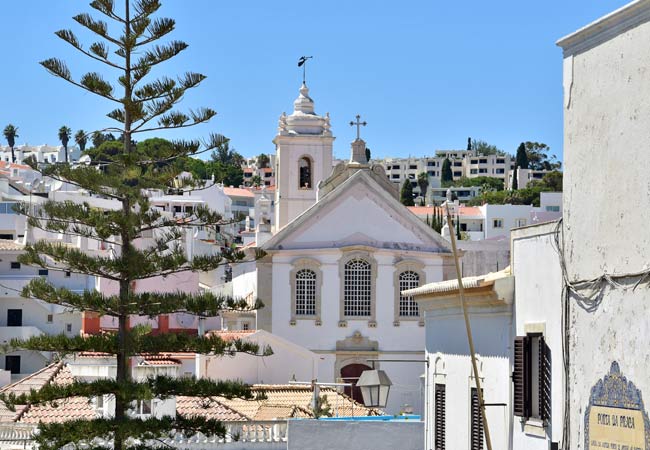
Albufeira's Old Town: the restaurants and bars stay open through November, but the summer crowds have gone
This is the month when I encouraged my brother and his pre-school aged family to come to Portugal. A week pottering around Albufeira, the kids playing on the beach by day, and a pace that let them forget the stresses of a busy life back at home. November is also the month my older parents come out for as long as they can to stay in pretty Tavira. They are drawn by the warm, dry weather, significantly better than back at home, and the sociable lifestyle: think all day in a waterfront café in Cabanas, chatting to every other resident or holidaymaker.
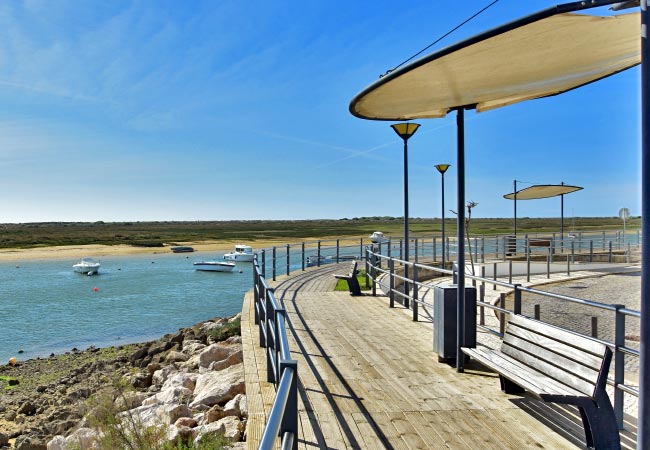
The waterfront at Cabanas, where my parents happily spend a whole day in a café
But the quiet does not mean there is nothing to do. I've had some of my best surfing days in November, based in Sagres, and I would only ever hike the Sete Vales Suspensos coastal path in the cooler months. Choose a calm day and the Benagil cave will be free from the crush of summertime tours, and from the number of golf bags I see on the flights, I can guarantee the golf is at its peak.
This guide will detail what to expect from a holiday to the Algarve in November, where to be based and how to make the most of your time. It is all based on my first-hand experience: exploring Portugal since 2001, living in Lisbon for the last six years, and a Portuguese wife who supplies the local insight.
The honest truth about November
Before going any further I want to be honest and not oversell the Algarve, even though I love the region. November is the low season and the weather isn't really suitable for the beach. Expect maybe six proper beach days in the whole month. It is also quiet, and for some people too quiet.
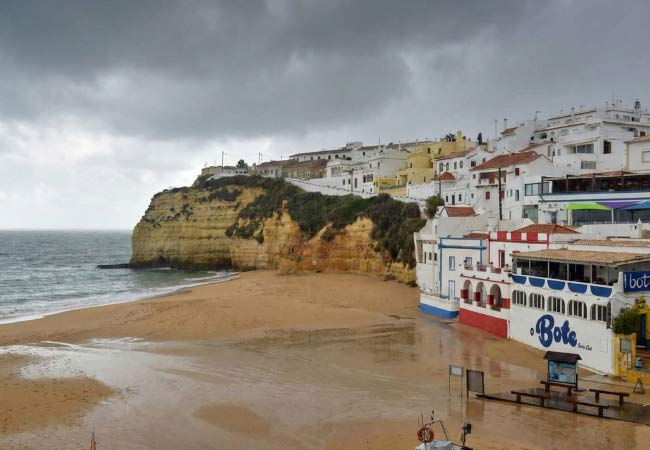
Carvoeiro under winter clouds. November has its grey days, but they rarely last long
On my wife's first winter trip to the Algarve, when we were both in our 20s, her view by the second day was "it's a bit dead, we should have stayed in Lisbon". And 20 years later it is still a fair summary: if you want life, energy, nightlife and a younger vibe, then look to Lisbon.
But for my parents and my brother, that same quiet is exactly what they wanted.
In summer the Algarve comes to you: flyers thrust in your face, tour kiosks everywhere and the infectious sounds of nightlife leading you to the bars. In November you make your own holiday. Hire a car, take day trips, and find the bar and restaurant that become your favourites.
Where you stay matters too, as not everywhere goes quiet. Lagos keeps its buzz thanks to a large laptop worker community, Sagres has its surfers, and the New Town in Albufeira still gets its group trips and stag dos, just at a lower level than in peak summer.
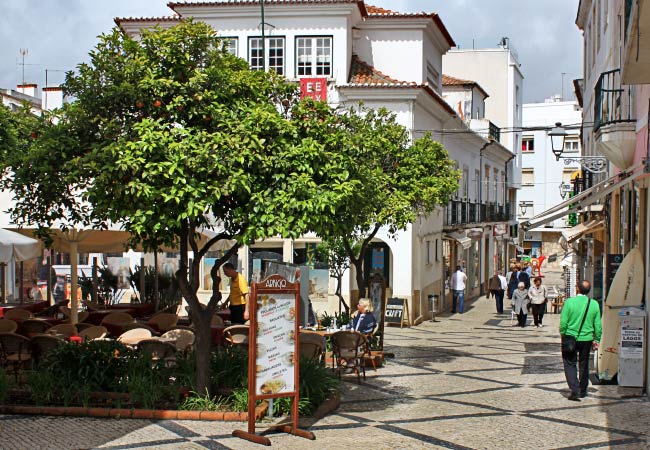
Lagos keeps its atmosphere through the winter, helped by a large community of remote workers
The weather of the Algarve in November
Below are weather charts for the Algarve, based on data from Faro, in the centre of the region.
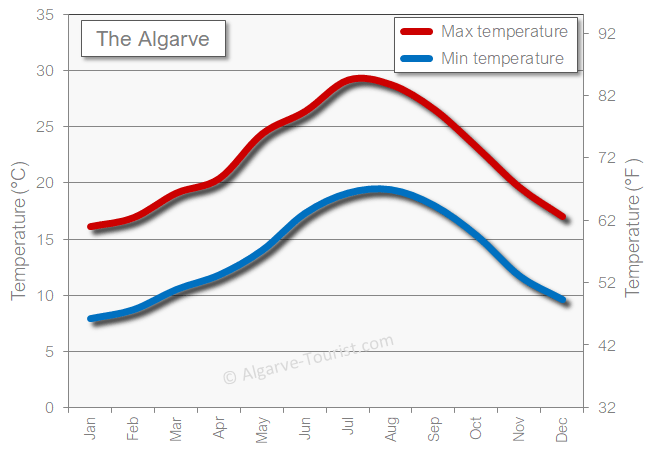
The average daytime maximum and the night-time minimum temperature for the Algarve
The official statistics are an average daytime maximum of 20°C (68°F) and a night-time minimum of 12°C (54°F). There will be eight days with some rain, often just a short passing shower, which is reflected in the low total of only 76mm. This is low in comparison to Lisbon with 120mm and Porto a very wet 170mm. For November I consider the Algarve dry, Lisbon unpredictable and Porto wet.
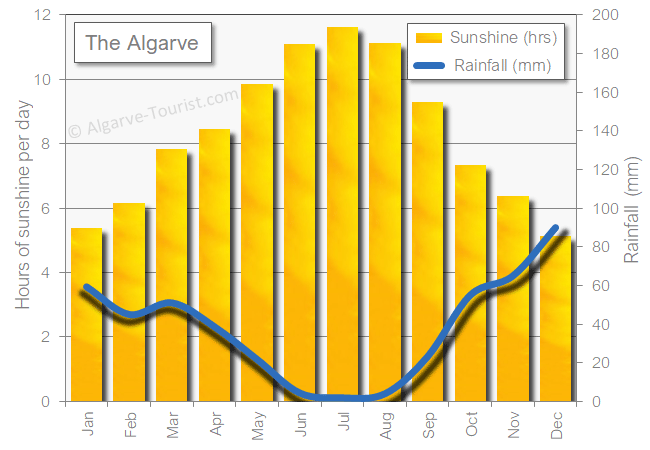
The average hours of sunshine per day and monthly rainfall (in mm)
Statistics mask what it’s actually like, which is bright, sunny and mildly warm, with rain that rarely lasts or is noticeable. Lunch will be eaten outside, but not dinner. You will need a light jacket once the sun sets, though my Portuguese mother-in-law will be wearing her thick jacket, dressed like she’s expecting snow.
The thing I notice the most in November is that the days get much shorter, with sunset at 17:25 in the middle of the month. As a positive, there is an average of 6.4 hours of sunshine per day.
The beginning of the month has much the better weather, and on a surprisingly warm day expect locals to say “Verão de São Martinho” (St Martin’s summer), a reference to the spell of high pressure that often falls around the feast day of São Martinho on 11 November.
The seas of Portugal are chilly all year round, and in November the water temperature is 18°C. So, chilly. For surfing I’m wearing a full 4mm wetsuit, and when my nephew ran into the sea, I wasn’t chasing him in.
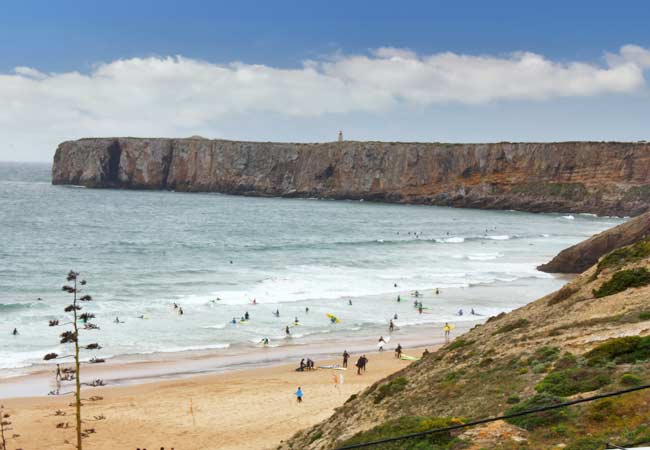
Surfing at Sagres: the waves are great in November, but it is a full wetsuit job
Ideas for activities and sights in November
Hiking the Sete Vales Suspensos: I enjoy hiking and I consider this one of the most scenic routes in Portugal. This clifftop route passes golden limestone cliffs, hidden grottoes and picturesque cove beaches, and ends at the beautiful Praia da Marinha. In the summer the 6km (12km round trip) can be a struggle in the heat, but November is ideal - Sete Vales Suspensos guide
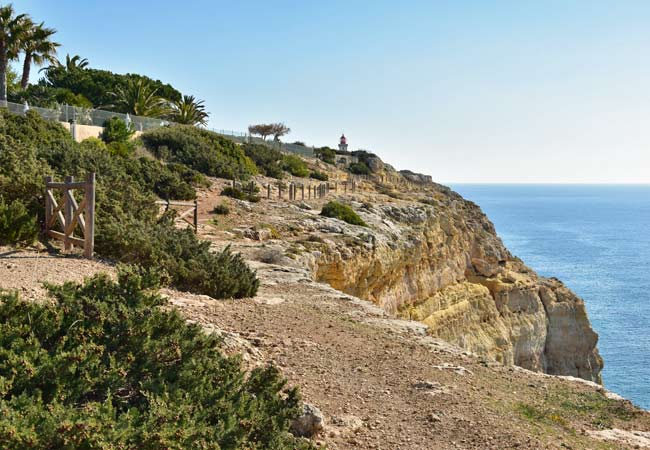
The Sete Vales Suspensos trail, far more enjoyable in the cool of November than in the summer heat
Day trip to Silves: Pretty Silves, packed with history, a large red sandstone castle, and if the wind is blowing in the right direction, the smell of oranges from the many orchards that surround the town. It’s not a large place and can be seen in a couple of hours, but add in lunch, a browse of the shops and a café stop for a pastry, and you have what I think is the perfect day trip - Silves guide
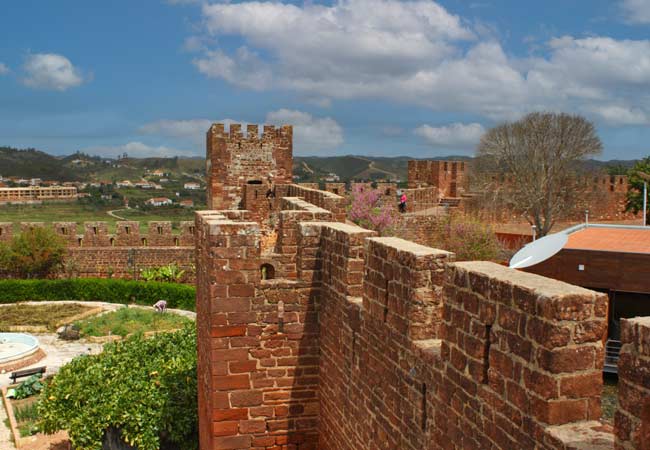
The red sandstone castle of Silves, the former Moorish capital of the Algarve
Boat trip to Benagil cave: The famous sea cave, with its domed chamber lined with toast-coloured strata, and light spilling through a hole in the roof onto the beach inside. This is a special place, but over the last few summers it has been ruined by its popularity. However, in November there will be far fewer boats and influencers, and its magic will return. My key advice is to only book this trip on a very calm day; you don’t want seasickness as the lasting memory.
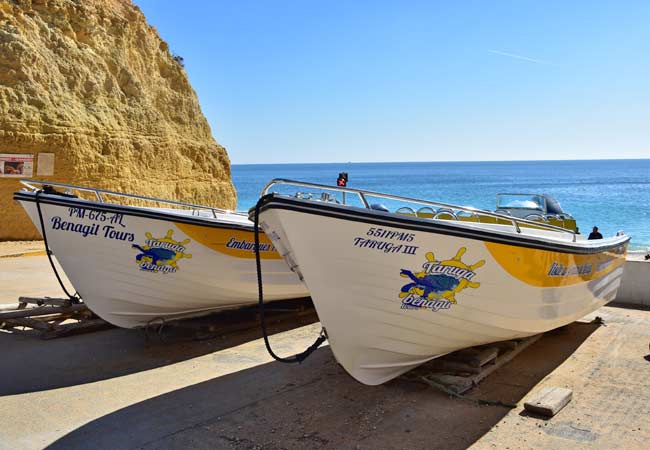
The tour boats at Benagil beach; in November there are far fewer of them competing for the cave
Kayaking: I always try to fit in a kayak trip while in the Algarve, usually a peaceful paddle around the Parque Natural da Ria Formosa with its birdlife and saltwater lagoons. The best sea kayaking is out at Lagos, paddling around the Ponta da Piedade headland, though in November the early winter waves may be too strong for sea trips. A wintertime alternative is the Ria de Alvor estuary, leaving from Alvor.
Day trip to Loulé: Sometimes I tire of the modern resort towns and the tourism focus of the coastline, and this is when I head to Loulé. This inland market town is one of the most authentic Portuguese towns in the region, with a lively covered market at its centre. On Saturdays the town comes alive, with a farmers’ market in the centre and a traditional market on the outskirts - Loulé guide
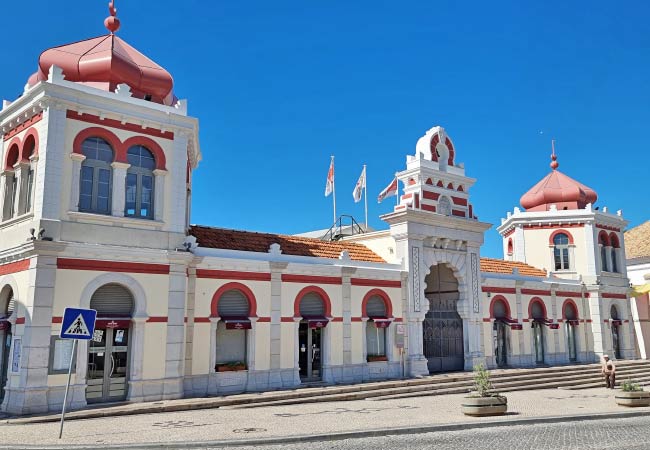
The covered market at the heart of Loulé, busiest on a Saturday morning
Surfing: Surfing in November is underrated. For anyone with a bit of experience there are the huge waves of Sagres, especially Praia do Tonel, which faces west out into the Atlantic. It is also a great season to learn, such as at Praia do Porto de Mós (Lagos). Even for younger children the waves are great for bodyboarding at Praia da Rocha, as my nephew will attest!
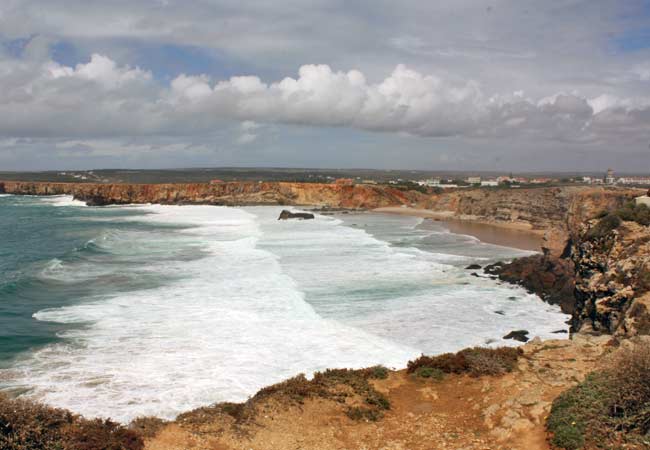
Praia do Tonel at Sagres faces straight out into the Atlantic and gets the biggest waves
Golf: I have to be honest, I am not a golfer and can’t get excited by it. But judging by the number of golf bags on my flights, and the groups eagerly talking about it in the bars of Vilamoura, November is the month for it. The big-name courses are clustered around Vilamoura, Quinta do Lago and Vale do Lobo.

From the number of golf bags on the flights, November is peak season for the Algarve's courses
Day trip to Faro: With its pretty historic centre encircled by city walls, and its pedestrianised shopping streets, I like Faro. Whenever I bring friends and family, though, they’re not interested in any of that. They want the Capela dos Ossos, a small chapel lined with the bones and skulls of more than a thousand monks - Faro guide
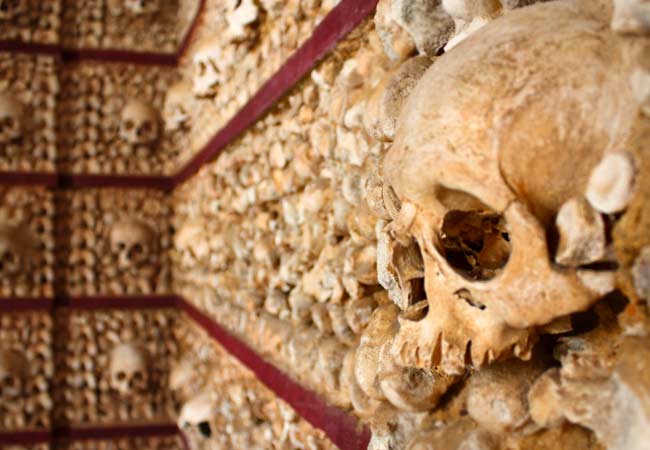
The Capela dos Ossos in Faro, the one sight every visiting friend and relative asks to see
Which town should you stay in?
There are many towns along the Algarve coastline, but in the low season I would always recommend being close to one of the larger ones with a permanent population, such as Lagos, Albufeira, Vilamoura or Tavira.
Smaller towns like Praia da Luz will feel very quiet. Those built around second homes and summer apartments, such as Armação de Pêra, Carvoeiro and Olhos de Água, can feel like ghost towns: entire apartment blocks behind closed shutters, and just a single café and restaurant open.
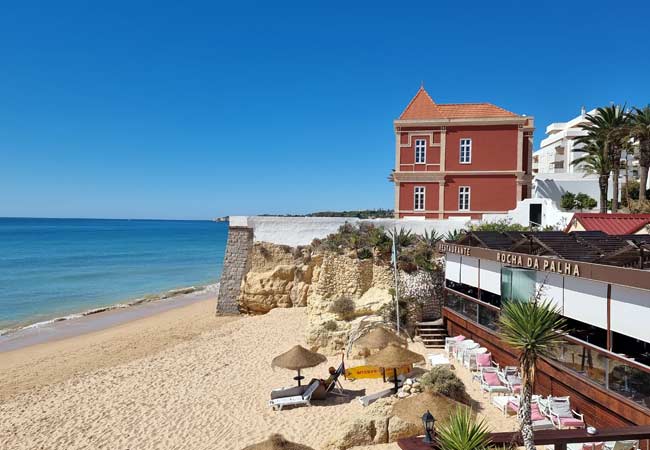
Armação de Pêra is lively in summer, but in November most of its apartments sit behind closed shutters
For most visitors to the Algarve in November I would recommend Lagos or Albufeira (the Old Town). Both have the majority of their restaurants, bars and shops open throughout the winter, and enough of an atmosphere to still feel like a holiday.
Albufeira is more central, and has the better beach for winter, sheltered by a headland from any westerly winds, so it always feels warmer. The historic centre is packed with restaurants, bars and tourist-focused shops, and on a bright sunny day it feels as if it were mid-June.
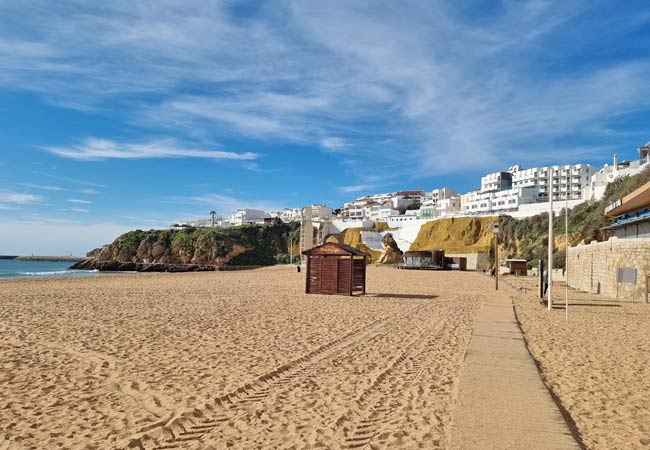
Albufeira's town beach is sheltered from the westerly winds, so it always feels a few degrees warmer
Departing from the harbour is a steady stream of boat tours, heading out to watch the dolphins, along the coast to the Benagil cave, or on thrill-seeking jet boat rides. I always prefer to spend my time in the Old Town, as the New Town and the Strip, with their themed bars and drinks promotions, somehow still feel rowdy at the weekends.
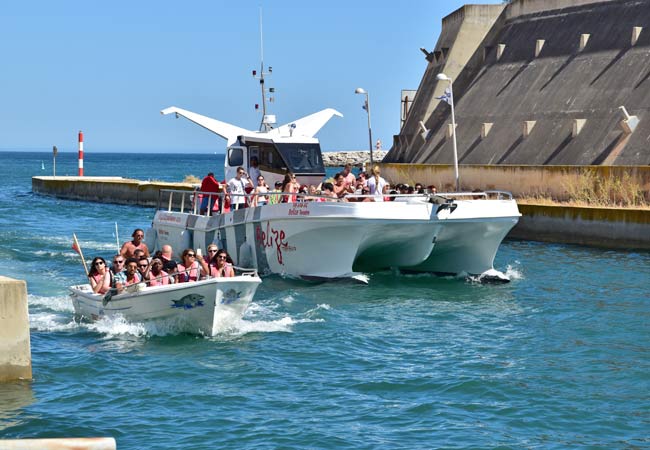
Boat tours from Albufeira run throughout November, weather permitting
My brother’s family trip here in November was a great success. It gave the parents time to relax from a hectic life, while the kids played on the beach and ate ice cream at any opportunity. It was a low-key holiday, but open enough for a romantic meal one evening and cocktails another. Albufeira for families
In November my choice of town is Lagos, and this is where I head when the weather in Lisbon turns for the worse. I like Lagos because it somehow combines three things that rarely seem compatible: locals, tourism and long-stay remote workers. It is a lived-in town with a life of its own beyond tourism. Portuguese is heard everywhere, and some restaurants have been run by the same family for generations. Alongside that is a newer crowd of digital workers, whose laptops fill the cafés each morning. Then come the tourists, with their boat tours of the Ponta da Piedade and all-day brunches. Albufeira, by comparison, is aimed purely at holidaymakers and its long-stay foreign winter residents. Our guide to Lagos
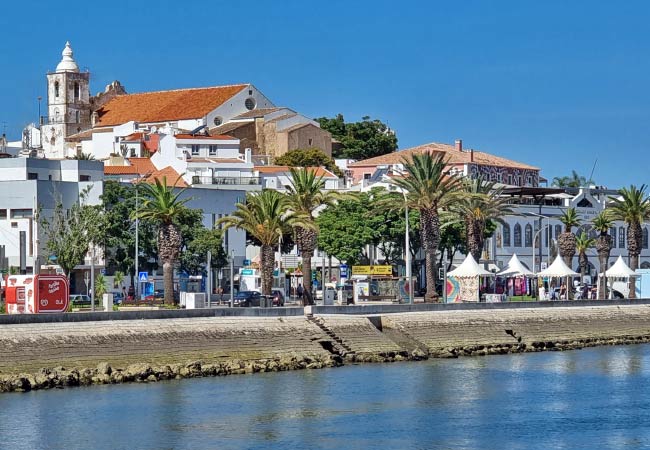
Lagos is a lived-in town with a life of its own beyond tourism
Far to the east of the Algarve is Tavira, a place my parents have fallen in love with, and where they spend as much of the winter as they can. It has the charm of a small Portuguese fishing town, where mornings are spent in a café doing not much, then pottering around the town, the riverfront or the near-deserted beaches. For me, Tavira in winter is too remote and quiet, but then I spend most of my time in Lisbon. For my parents, though, it is ideal: warm, calm, safe and friendly, which is all they really want from a holiday. Our guide to Tavira
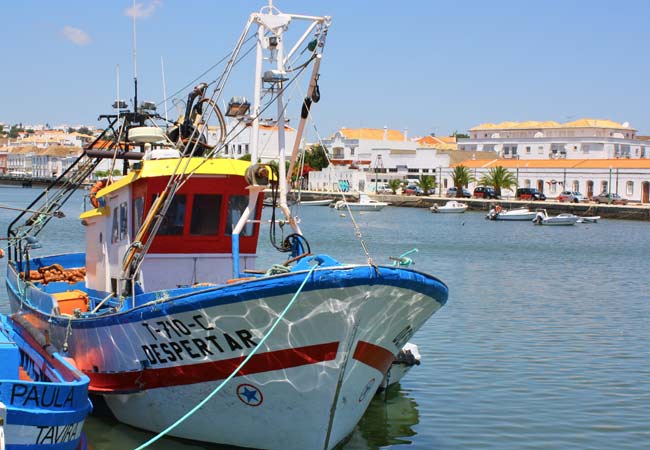
Tavira, where my parents spend as much of the winter as they can
Albufeira for families, Lagos for most, Tavira for the slow version, Lisbon if you want nightlife. Where to stay in the Algarve
Tips for accommodation in November
If you are choosing accommodation in November, think about pools. You will want a heated (and possibly indoor) pool, which usually means a large hotel complex. The cool weather and chilly water of an outdoor pool make it a backdrop for photos rather than something you would choose to use. Apartments and villas with unheated pools are even more of a gimmick, and certainly not worth paying more for.
Evenings can get chilly towards the end of the month, and if, like my wife, you feel the cold, check that a rental apartment or villa has some form of heating, usually via the air conditioning unit.
There can be steep discounts on accommodation, often at the larger hotel complexes. Many of the booking sites pre-reserve rooms throughout the year, so it is worth checking a few different websites once you have settled on a hotel.
For how November compares across the country, please see our Portugal in November guide.
Our most popular guides to the Algarve


About the author: I'm Philip Giddings and have been writing these independent guides since 2009. I first visited the Algarve in 2001 when my Portuguese wife, Carla, was proud to show her country to me. We now live in Lisbon but I'm in the region most weeks researching and updating this site or visiting Carla’s extended family who live here. Having both Portuguese-family and friends who live within the Algarve gives me the local insight and personal connection to the region.
I love the Algarve region and strive to ensure every practical detail (such as ticket prices, opening hours) is correct, by checking against official sources and confirming in person on the many trips I make. I am experienced in Portuguese travel having written almost 2,000 guides for my wider set of Portugal Guides, and this is my full-time work and passion. The site is funded by affiliate commissions on tour and accommodation bookings, disclosed on every page that carries them. No tourist board, tour operator or attraction pays to appear here. My full story can be read here.