Algarve-Tourist.com
The best independent guide to the Algarve
Algarve-Tourist.com
The best independent guide to the Algarve
Top 10 Algarve: highlights & best things to do and see (updated for 2026)
The Algarve offers one of Europe's most diverse holiday experiences. This southern Portuguese coastline combines pristine natural scenery, traditional fishing villages, and lively resort towns within a compact region that takes just two hours to drive from end to end.
The variety here suits almost any type of traveller. Families find safe beaches and world-class waterparks. History enthusiasts discover Moorish castles and ancient fishing traditions. Food lovers explore fresh seafood markets and regional dishes. Adventure seekers surf Atlantic waves or hike dramatic clifftop trails. And those wanting to simply relax can choose between secluded coves and buzzing beach bars.
This guide details the ten best sights and ten best activities across the Algarve, from the quiet eastern towns near the Spanish border to the wild surfing beaches of the west.
The Top 10 Sights and Activities in the Algarve
- Top 10 sights and places to visit in the Algarve
- 10) Vila Real de Santo António: A peaceful riverside town with grand Baroque architecture and a pretty waterfront overlooking the Spanish border.
- 9) Benagil Cave: A spectacular sea cave with golden walls and an enclosed beach, illuminated by sunlight streaming through a hole in the ceiling.
- 8) The Bone Chapel, Faro: A macabre chapel lined with the bones and skulls of over 1,100 monks, offering a sobering reminder of mortality. Bone Chapel
- 7) Cabo de São Vicente: The windswept southwestern tip of mainland Europe, where colossal waves crash against towering cliffs. Cabo de São Vicente
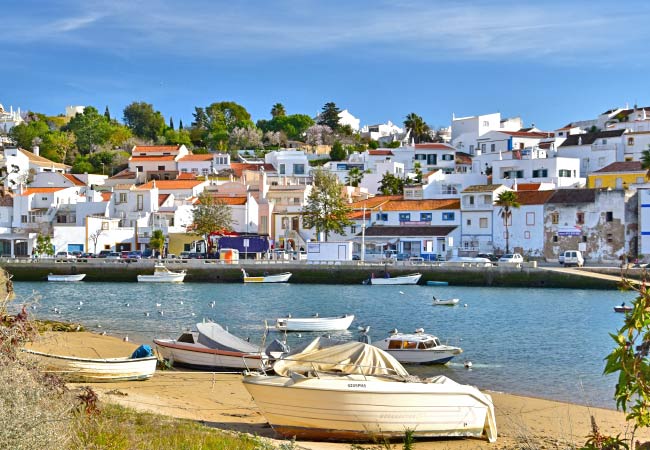
- 6) Ferragudo: One of the last unspoilt fishing villages in the central Algarve, with a traditional harbour and genuine Portuguese character.
- 5) The Anchor Cemetery, Barril Beach: A haunting memorial of rusting anchors marking a failed tuna fishing community, set among the dunes of a beautiful eastern beach. Guide to Barril Beach
- 4) Praia da Marinha: Frequently ranked as the Algarve's most beautiful beach, with golden cliffs, turquoise waters, and a distinctive double sea arch. Praia da Marinha
- 3) Castelo de Silves: An imposing redbrick Moorish castle overlooking a charming town that once served as the capital of the entire Algarve. Guide to Silves
- 2) Ponta da Piedade: A headland of misshapen cliffs, sea arches, and hidden grottos carved into golden sandstone south of Lagos. The Ponta da Piedade
- 1) Tavira: The quintessential Portuguese town, straddling a river with a castle, thirty churches, and traditional tiled houses lining cobbled streets. Guide to Tavira
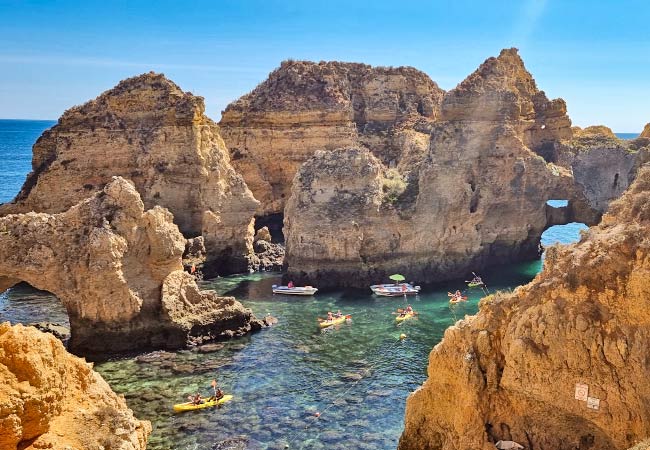
The Ponta da Piedade
- Top 10 activities for your holiday to the Algarve
10) Exploring Loulé's Markets: Discover authentic Portugal at a daily covered market and a chaotic Saturday gypsy market selling local produce, fish, and handicrafts. Guide to Loulé Markets - 9) Partying at The Strip, Albufeira: Experience over fifty bars and five nightclubs along one of Europe's liveliest party streets.
- 8) Riding the Flumes at Slide & Splash: Cool off at one of three outstanding waterparks offering gravity-defying slides and pools for all ages.
- 7) Boat Tours of Parque Natural da Ria Formosa: Cruise through protected lagoons and mudflats that shelter migrating birds, traditional fishing communities, and the world's highest concentration of seahorses. Guide to Ria Formosa
- 6) Eating Cataplana: Share the Algarve's signature dish, a delicious seafood stew served in a clam-shaped copper pot.

- 5) Wine Tasting at a Vineyard: Discover the Algarve's emerging wine region by touring a scenic estate, learning about local production, and sampling award-winning wines in the sun - Vineyard guide
- 4) Surfing at Sagres: Catch powerful Atlantic waves at the western tip of the Algarve, where a laid-back surf town offers schools, rentals, and beaches facing three directions.
- 3) Dolphin Watching by Boat: Join a tour from any major resort to see pods of dolphins travelling between the Mediterranean and the Atlantic.
- 2) Kayaking or SUP to Sea Caves: Glide through crystal-clear waters to explore hidden grottos and beaches around Ponta da Piedade or Praia da Marinha, reaching spots inaccessible to larger boats.
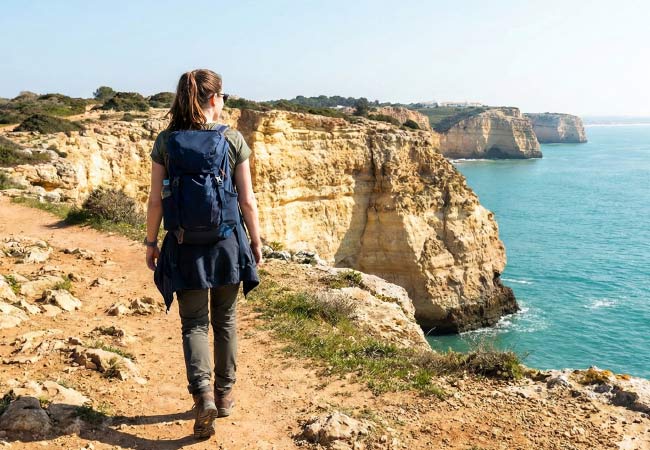
- 1) Hiking the Sete Vales Suspensos Trail: Walk a 6km clifftop path past hidden coves, untouched beaches, and some of the most beautiful coastal scenery in southern Portugal. Guide to the Sete Vales Trail
The map below shows the location of the top 10 sights and activities; the sights are marked in green and the activities in yellow.
Sights (green):
1) Tavira
2) Ponta da Piedade headland
3) Castelo de Silves and town
4) Praia da Marinha beach
5) Anchor cemetery, Barril beach
6) Ferragudo
7) Cabo de São Vicente
8) Bone Chapel, Faro
9) Benagil cave
10) Vila Real de Santo António
Activities (yellow): 1) Sete Vales Suspensos coastal path
2) The Strip, Albufeira
3) Dolphin watching
4) Surfing in Sagres
5) Old Course Vilamoura
6) Cataplana restaurants
7) Ria Formosa Natural Park
8) Slide & Splash
9) Castles of Castro Marim
10) Markets in Loulé
The following section details the best sights and activities of the Algarve and explains why they are in our top 10 list.
No.10 Sight: Vila Real de Santo António
Vila Real de Santo António sits on the banks of the Guadiana River at the far eastern edge of the Algarve, just a few hundred metres from Spain.
The town's grand Baroque centre was built in just five months in 1774, using the same grid layout and architectural style as Lisbon's Baixa district, which had been reconstructed after the 1755 earthquake. The central Praça Marquês de Pombal remains one of the finest public squares in southern Portugal, lined with orange trees and traditional black and white paving.
Beyond the historic centre, a waterfront promenade follows the river north, offering views across to the Spanish town of Ayamonte. Ferries make the ten-minute crossing throughout the day, allowing visitors to add a second country to their holiday with minimal effort.
South of Vila Real, the coastline transforms into a series of quiet beaches backed by pine forests, a contrast to the busier sands of the central Algarve. The town makes an easy day trip for those staying in the eastern region, combining well with the nearby castle town of Castro Marim.
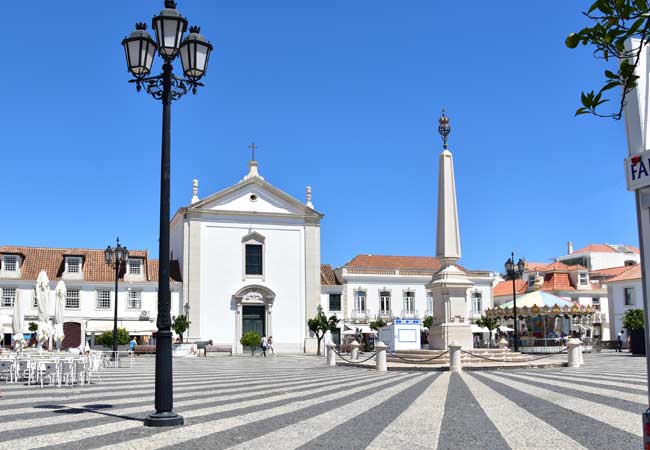
Orange trees and traditional black and white paving in the Praça Marquês de Pombal
No.10 Activity: Exploring the Markets of Loulé
Loulé offers the most authentic market experience in the Algarve, drawing locals and visitors to a town that has served as a trading hub since Moorish times.
The centrepiece is the Mercado Municipal, a covered market housed in a striking building with Moorish-inspired arches and red domes. Open every morning except Sunday, the stalls inside sell fresh fish, locally grown fruit and vegetables, cured meats, cheeses, and traditional handicrafts. Arriving early provides the best selection and a chance to watch local restaurateurs choosing their ingredients for the day.
Saturdays bring the town to life with two additional markets. A large gypsy market spreads across the outskirts, selling everything from clothing and household goods to live chickens. Closer to the centre, a farmers' market offers organic produce, honey, and homemade preserves direct from local smallholdings. The combination of all three markets makes Saturday morning the best time to visit.
Loulé itself rewards exploration beyond the market halls. The old quarter contains narrow streets, traditional workshops, and a 13th-century castle, making the town a worthwhile day trip rather than just a quick stop.
Related articles: Guide to Loulé
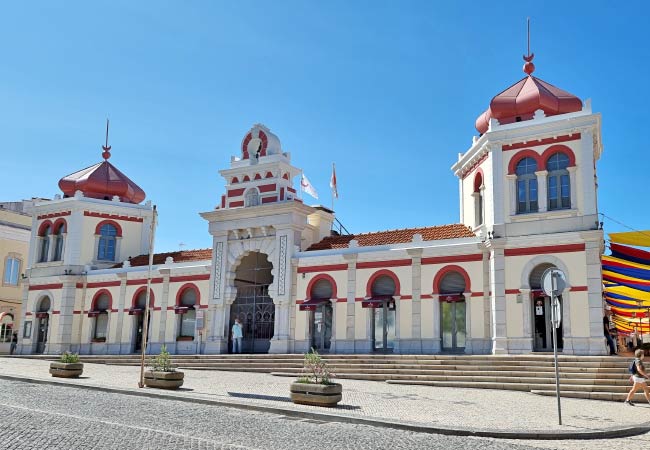
The Mercado Municipal, with its distinctive Moorish-inspired architecture
No.9 sight - Benagil cave
The Algar de Benagil is the defining image of the Algarve and one of the most famous natural landmarks in Portugal.
This immense sea cave features a domed ceiling with a circular opening at the top, known locally as the "eye." When the midday sun streams through, it illuminates the golden sandstone walls and the small beach inside, the light shifting as the hours pass.
Benagil suffers from its own popularity. During summer, the waters outside become chaotic with hundreds of tour boats, kayaks, and paddleboards competing for space. This overcrowding has prompted strict regulations: swimming to the cave is now prohibited for safety reasons, and most motorised boats can no longer let passengers disembark onto the sand.
The cave remains stunning, but the experience can feel frantic rather than peaceful. To appreciate it at its best, join a kayak or paddleboard tour at sunrise before the crowds arrive.

The Algar de Benagil is spectacular, but expect to share the view with many others
No.9 Activity: Partying at The Strip, Albufeira
The Strip is the nightlife capital of Portugal. This neon-lit avenue in the Montechoro district draws thousands of young holidaymakers every summer, most aged 18 to 30 and looking for big nights out.
Over fifty bars line Avenida Sá Carneiro, each competing for attention with drinks promotions and staff on the street luring you inside. The atmosphere builds through the evening, with bars filling after midnight and clubs opening around 3am.
La Bamba has been a Strip institution for over twenty years, known for Latin party anthems and a packed dance floor. Matt's Bar draws a young British crowd with resident DJs. Wild & Co offers live music for those wanting a break from the DJ sets. The main clubs include Heaven and Vida, both staying open until 6am.
The Strip is not for everyone. Stag and hen parties dominate, and the chaos can feel overwhelming. But for those seeking exactly that, nowhere else in Portugal compares.

No.8 Sight: The Capela dos Ossos (Bone Chapel), Faro
The Capela dos Ossos is one of the most unusual sights in southern Portugal. This small chapel, tucked behind the Igreja do Carmo in Faro's old town, is lined from floor to ceiling with the bones and skulls of over 1,100 Carmelite monks.
The chapel was constructed in the 19th century when the adjoining cemetery became overcrowded. Rather than dispose of the remains, the monks incorporated them into the walls, arranging skulls into geometric patterns and stacking bones to form pillars. The effect is both unsettling and strangely beautiful.
Above the entrance, an inscription reads: "Stop here and consider, that you will arrive at this state too." The message was intended to remind the living of their mortality, encouraging a pious life. Today it serves as a sobering counterpoint to the beach holidays and sunshine that draw most visitors to the Algarve.
The chapel takes only a few minutes to visit but leaves a lasting impression. It combines well with a wider exploration of Faro's historic centre.
Related articles: Capela dos Ossos - Faro sights
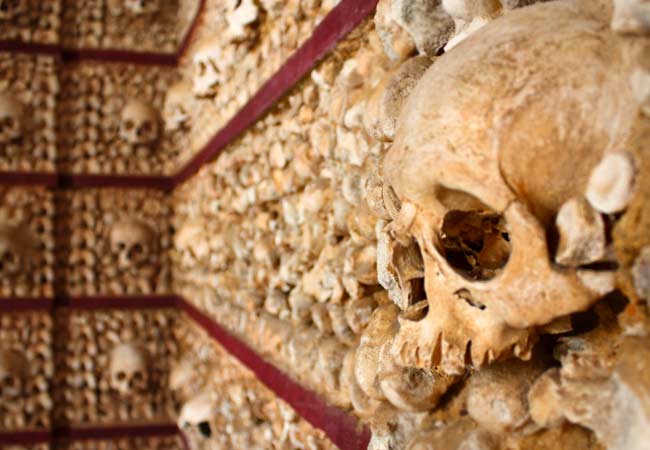
The remains of over 1,100 monks line the chapel walls
No.8 activity – The Algarve's waterparks
When summer temperatures push past 35°C, the Algarve's three waterparks offer the perfect escape from the heat.
Slide & Splash near Lagoa is the largest, spreading across landscaped grounds filled with palm trees. Thrill-seekers head for the Banzai and Tornado slides, where near-vertical drops deliver stomach-churning speeds, while families find gentler options in the wave pool and dedicated splash zones.
Aquashow near Quarteira combines water rides with a full amusement park, including roller coasters and live entertainment. Aqualand near Alcantarilha completes the trio, with its signature Kamikaze slide remaining one of the most intimidating drops in the region.
All three parks operate from late May to September, charging around €30 to 35 for adults.
www.slidesplash.com
www.aquashowparkhotel.com
www.aqualand.pt

Slide & Splash is the largest of the Algarve's three waterparks
No.7 sight - The Cabo de São Vicente
Standing at the southwestern tip of mainland Europe, Cabo de São Vicente was once believed to mark the edge of the known world. Medieval sailors gazed westward from these cliffs into an ocean they thought endless, a place where sea monsters lurked and ships simply vanished.
The headland remains a place of raw, elemental power. Colossal Atlantic waves explode against cliffs that drop seventy metres to the churning water below. Relentless winds scour the promontory, leaving only the hardiest scrub clinging to the rocky ground. A 19th-century lighthouse stands defiant against the elements, its beam reaching 60 kilometres out to sea.
A visit to Cabo de São Vicente is often combined with a trip to Sagres.
Related articles: Sagres guide
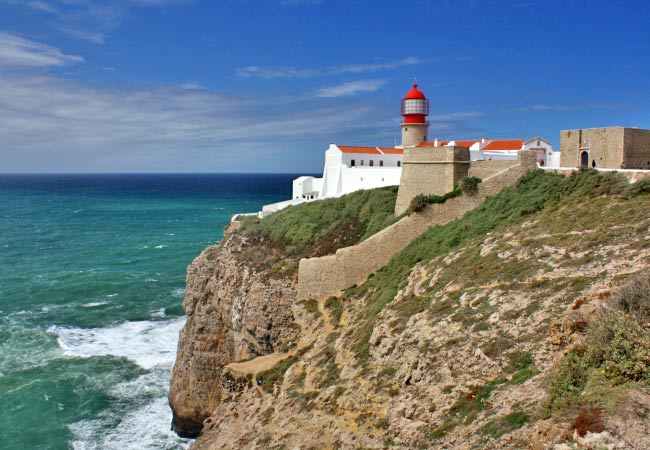
The light from the Cabo de São Vicente lighthouse can be seen up to 60km out to sea
No.7 Activity - A boat tour of Parque Natural da Ria Formosa
The Ria Formosa stretches for sixty kilometres along the eastern Algarve, a protected labyrinth of lagoons, salt marshes, and barrier islands that feels utterly removed from the busy resorts just minutes away.
Boat tours depart from Faro and Olhão, gliding through shallow channels where wading birds pick through the mudflats and fishermen still use traditional clay pots to catch octopus. The park shelters an extraordinary range of wildlife: flamingos wade through the shallows, spoonbills sweep their curved bills through the water, and the lagoons support the world's highest concentration of seahorses.
Most tours stop at Ilha Deserta, a pristine barrier island with no permanent residents. At its southern tip sits the Cabo de Santa Maria, the most southerly point of mainland Portugal. Beaches here stretch for kilometres, often with barely another person in sight.
The Ria Formosa offers a glimpse of an older, slower Algarve, where traditional fishing communities have worked these waters for generations. For those tiring of crowded sands and busy promenades, a morning on these quiet lagoons provides a welcome contrast.

The calm waterways of the Parque Natural da Ria Formosa
No.6 sight - Ferragudo
Ferragudo sits on the western bank of the Arade estuary, a quiet fishing village that has somehow resisted the development that transformed neighbouring Portimão and Praia da Rocha into high-rise resorts.
Whitewashed cottages climb the hillside from a working harbour where weathered fishermen still mend nets and unload the morning catch. Narrow lanes wind between traditional houses adorned with azulejo tiles, opening suddenly onto small squares where locals gather in the shade. The village church crowns the hill, offering views across the estuary to Portimão's marina.
South of the village, the coastline reveals two excellent beaches. Praia Grande stretches beneath the walls of a 16th-century fortress, while the smaller Praia dos Caneiros sits tucked between ochre cliffs, backed by a single seafood restaurant rather than the usual strip of tourist bars.
Ferragudo rewards those seeking authentic Portugal without venturing far from the central Algarve's main attractions.
Ferragudo is a delightful fishing village
No.6 activity – Eating a Cataplana
Before tourism arrived, fishing sustained the Algarve for centuries. That maritime heritage lives on in the region's cuisine, and no dish captures it better than the cataplana.
Named after the distinctive clam-shaped copper pot in which it cooks, a cataplana arrives at the table sealed shut, trapping the aromas inside. The waiter unclips the lid with a flourish, releasing a fragrant cloud of steam that announces the feast to come. Inside, prawns, clams, fish, and chunks of chouriço swim in a rich broth of tomatoes, white wine, garlic, and fresh coriander.
The dish is designed for sharing, and variations abound, from monkfish and seafood versions to pork and clam combinations that marry the mountains with the sea.
A seafood Cataplana is to be shared
No.5 sight - The Cemitério das Âncoras (anchor cemetery)
Hundreds of rusting anchors stand in the dunes behind Barril beach, a haunting memorial to a way of life that vanished within a single generation.
For centuries, fishermen from this remote stretch of coast caught Atlantic bluefin tuna using an elaborate system of nets held in place by these very anchors. The work was brutal and the rewards immense: tuna fetched high prices across Europe. But by 1966, overfishing had decimated stocks beyond recovery, and the community simply walked away, leaving their anchors to the sand and salt air.
Today the anchors stand in silent rows, slowly surrendering to rust while tourists pass on their way to the beach. A miniature railway, once used to transport the catch, now carries visitors across the marshes from the village of Santa Luzia.
Barril itself ranks among the finest beaches of the eastern Algarve, its golden sands all the more poignant for the story behind them.
Related articles: The Praia do Barril
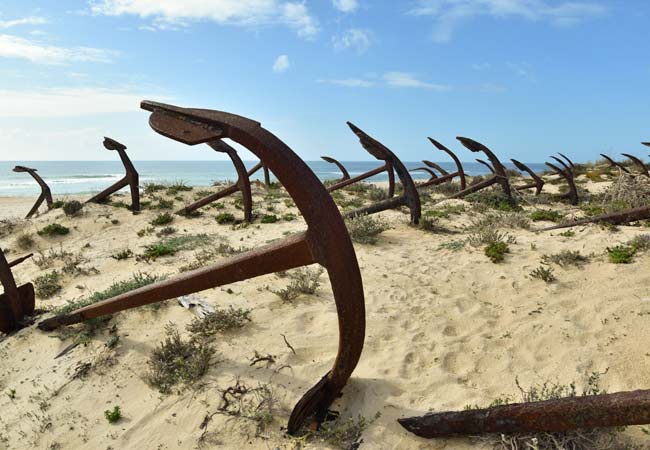
Hundreds of anchors were used to secure the complex nets structures needed to fish for tuna
No.5 Activity: Wine Tasting at a Vineyard
The Algarve's wine country remains one of the region's best-kept secrets. While visitors crowd the beaches, a new generation of winemakers has quietly transformed the inland hills into a serious wine destination.
Vines have grown here since Roman times. Today's producers blend traditional Portuguese varieties with international grapes, experiment with organic methods, and craft wines shaped by hot summers and cooling Atlantic breezes.
Most estates cluster around Lagoa, Silves, and Estômbar, an easy half-hour drive from the coast. Standouts include Morgado do Quintão, where lunch beneath a 2,000-year-old olive tree has become a signature Algarve experience, and Quinta dos Vales, a 44-hectare estate offering hands-on bottle-blending workshops alongside an outdoor sculpture collection.
Advance booking is essential. These are small, family-run operations, not sprawling visitor centres. Three or four estates make a comfortable day trip.

The inland hills around Lagoa and Silves have become a serious wine destination
No.4 Sight: Praia da Marinha
Praia da Marinha regularly appears on lists of Europe's finest beaches, and it earns the recognition. Golden sandstone cliffs frame a sheltered cove where clear turquoise waters lap against soft sands,
The beach takes its name from the rock pools scattered across its shallows. At low tide these fill with crabs, anemones, and small fish, making them a favourite with children and snorkellers alike. The cliffs above are equally worth exploring: a short path leads to viewpoints that reveal the coastline in all directions.
At the western end of the beach, erosion has carved a double sea arch into the headland, forming a distinctive M-shaped silhouette that has become one of the most photographed landmarks on the Algarve coast. The arch is best appreciated from the water, either by kayak or on a boat tour departing from nearby Benagil.
Marinha gets busy in summer, but the scenery justifies its popularity. Arriving early or visiting in the shoulder season allows you to appreciate the beach at its peaceful best.
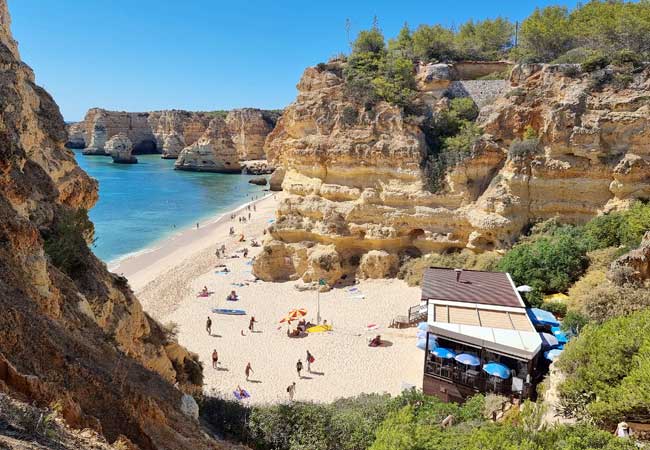
Golden sandstone cliffs frame the sheltered cove at Praia da Marinha
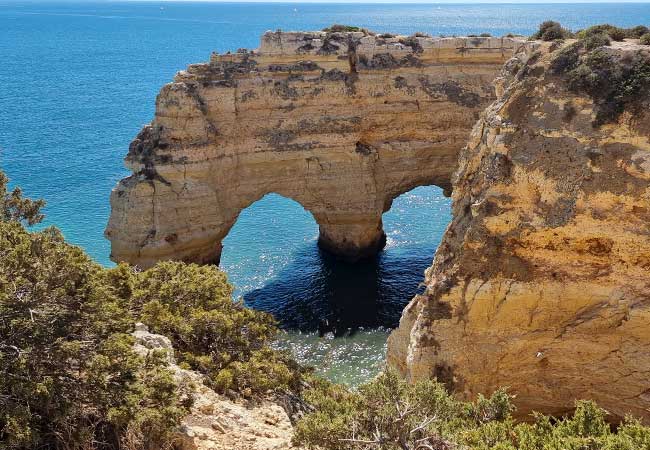
The double arch of the Arcos Naturais
No.4 Activity: Surfing at Sagres
Sagres sits at the far western tip of the Algarve, a windswept town of whitewashed buildings perched above some of the most powerful waves in Portugal.
The town's appeal to surfers lies in its geography. The headland faces three directions, so when conditions are blown out on one beach, another is likely to offer clean waves. Praia do Tonel catches the southern swells and suits intermediate surfers, while Praia do Beliche to the north delivers heavier breaks for those with more experience. Beginners head to the gentler waters of Praia da Mareta, sheltered within the harbour.
Sagres has built its identity around the surf. Board rental shops and schools line the main street, hostels cater to travelling surfers on tight budgets, and the bars fill each evening with sun-tired faces comparing the day's waves. The town has a scruffiness to it, a handful of streets that look like they could use a coat of paint, but this only adds to the laid-back atmosphere.
Related articles: Sagres guide

The Praia do Beliche beach is one of the most popular and best locations for surfing
No.3 Sight: Silves and the Castelo de Silves
For three centuries, Silves was the most important city in the Algarve. Under Moorish rule from the 9th to 12th century, it served as the regional capital, a prosperous trading hub whose wealth and culture rivalled Lisbon. The castle that crowns the hilltop today dates from this era, its distinctive red sandstone walls visible for miles across the surrounding orange groves.
The Castelo de Silves remains one of the best-preserved Moorish fortifications in Portugal. Walking its ramparts offers views across the town and down to the river that once carried trading vessels inland from the coast. Inside the walls, excavations have uncovered Moorish cisterns and the outlines of the palace that stood here before the Christian reconquest of 1249.
Below the castle, the old town rewards exploration on foot. Narrow streets wind past the Gothic cathedral, built on the site of the former mosque, and down to the medieval river bridge. Silves feels unhurried compared to the coastal resorts, its cafés and restaurants catering more to locals than tourists.
Related articles: Silves introduction
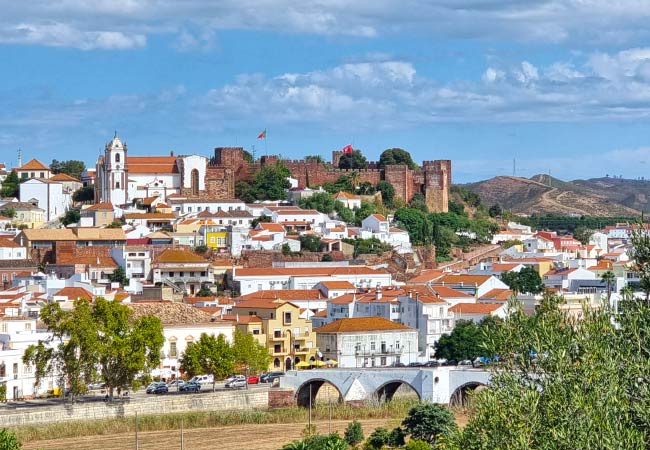
The red sandstone battlements of the castle rise high above the town
No.3 Activity: Dolphin watching by boat
Large pods of dolphins pass along the Algarve coastline throughout the year, travelling between the warm waters of the Mediterranean and the food-rich Atlantic. Common dolphins are the most frequently spotted, often in groups of twenty or more, and bottlenose dolphins also appear regularly.
Boat tours depart from most resort towns, with Lagos, Albufeira, and Vilamoura among the most popular starting points. The trips typically last two to three hours, heading out into open water where the crew scan for signs of activity. Many tours combine dolphin watching with a cruise along the coastline, passing the sea caves, arches, and grottos near Benagil and Ponta da Piedade. This makes for a satisfying half-day excursion even if the dolphins prove elusive.
The tour operators along this coast follow responsible viewing guidelines, keeping their boats at a safe distance and cutting engines when dolphins approach. The animals often seem curious rather than disturbed, swimming alongside the boats or riding the bow wave before continuing on their way.

A dolphin surfacing just in front of Benagil cave and the Praia da Corredoura beach
No.2 sight - The Ponta da Piedade
South of Lagos, the coastline fractures into a maze of golden cliffs, sea arches, and hidden grottos that ranks among the finest coastal scenery in Europe.
The Ponta da Piedade has been shaped by millennia of Atlantic storms. Winter swells have punched tunnels through the soft sandstone, carved pillars that stand isolated from the mainland, and hollowed out caves that glow amber when the sun hits their walls. The rock formations here look almost sculptural, their surfaces weathered into ridges and hollows that catch the light differently with each passing hour.
From the clifftops, a wooden staircase descends to a small jetty where local boatmen wait to take visitors on tours of the headland. These small vessels can navigate passages too narrow for larger boats, gliding beneath arches, into echoing caverns, and past rock faces that tower overhead.
Related articles: Lagos introduction – The Ponta da Piedade
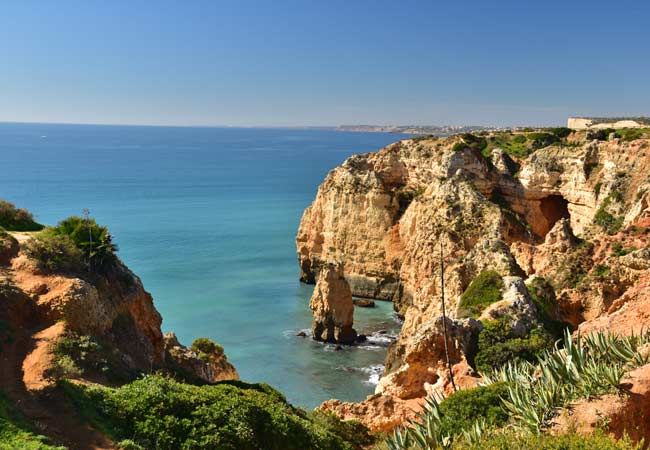
Golden cliffs and turquoise sea waters, the Ponta da Piedade is stunning
The unique cliff formations are best viewed by boat
No.2 Activity: Kayaking or SUP to the sea caves
The Algarve's coastline is riddled with sea caves, hidden beaches, and rock formations that can only be reached from the water. While boat tours offer one way to see them, a kayak or paddleboard brings you closer, allowing you to slip through narrow arches, drift into echoing grottos, and land on tiny beaches where no path leads.
The two finest stretches for paddling are around Ponta da Piedade near Lagos and the cliffs between Benagil and Praia da Marinha. At Ponta da Piedade, a labyrinth of sea stacks and tunnels opens up at water level, the golden sandstone glowing in the morning light. Near Benagil, the famous sea cave draws the crowds, but smaller caverns and hidden coves lie scattered along the same coastline, most of them empty.
For calmer waters, the Ria Formosa near Faro and Olhão offers a different experience entirely. Here you paddle through sheltered lagoons and tidal channels, passing salt marshes, oyster beds, and sandbanks where wading birds gather. The Alvor estuary west of Portimão provides a similar setting on a smaller scale, its calm waters well-suited to beginners and families.
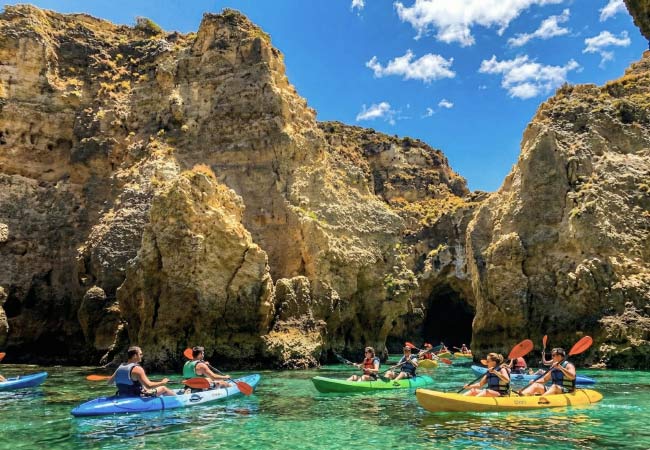
A kayak allows you to slip through arches and into caves inaccessible to larger boats
No.1 Sight: Tavira
Tavira is the town that visitors picture when they imagine traditional Portugal. Whitewashed houses with terracotta roofs rise from the banks of the Gilão River, their facades decorated with the painted tiles that have adorned Portuguese buildings for centuries. A Roman bridge crosses the water at the town's heart, linking two halves of a settlement that has thrived here since antiquity.
The town rewards aimless wandering. Thirty churches are scattered across its streets, some dating to the 13th century when Tavira was wrested from Moorish control. A hilltop castle offers views across the rooftops to the salt marshes and lagoons of the Ria Formosa beyond. Shaded squares provide places to rest with a coffee, while the covered market sells fresh fish hauled from the waters just offshore.
Tavira benefits from its location in the quieter eastern Algarve, far from the crowds and construction of the central coast. The town feels genuinely Portuguese rather than adapted for tourists: locals still outnumber visitors in the cafés, and the pace of life slows to something closer to the Algarve of decades past.
Related articles: Tavira guide
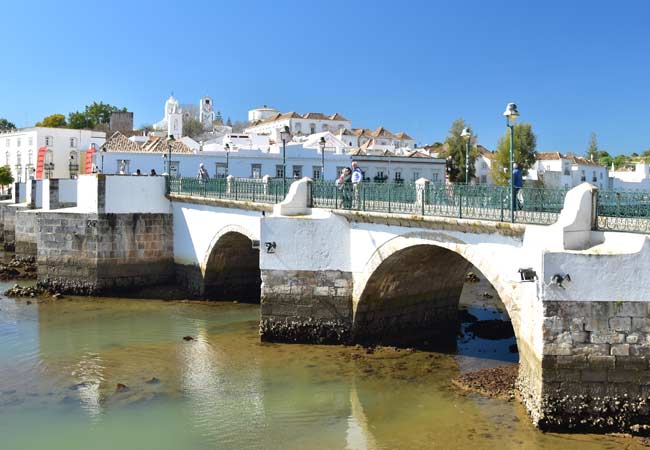
The Roman bridge links the two halves of Tavira's historic centre
No.1 Activity: Hiking the Percurso dos Sete Vales Suspensos trail
A 6km hiking trail as the best activity in a region known for its beaches, golf courses, and boat tours may seem an odd choice. Walk it once and the ranking makes sense.
The Sete Vales Suspensos, or Seven Hanging Valleys trail, follows the clifftops between Praia da Marinha and Praia do Vale de Centeanes, passing through some of the finest coastal scenery in southern Europe. The path dips into valleys thick with wild herbs, skirts clifftops where the rock has collapsed into arches and sea stacks, and offers views down to coves accessible only by boat or steep scramble. At points the cliffs drop sheer to the water seventy metres below, the sandstone glowing gold against the deep blue of the Atlantic.
Along the way, the trail passes directly above the Benagil Cave, its famous circular skylight visible from the clifftop. A set of stairs at Benagil beach allows walkers to break the hike with a swim or arrange a short boat trip into the cave itself.
The official trail ends at Vale de Centeanes, but continuing west adds further rewards. Another kilometre brings you to the Algar Seco rock formations, where wooden boardwalks wind between weathered pillars and a natural window frames the sea. From here, it is a short walk into Carvoeiro, a former fishing village with restaurants and bars.
Related articles: The Percurso dos Sete Vales hiking trail – Carvoeiro introduction
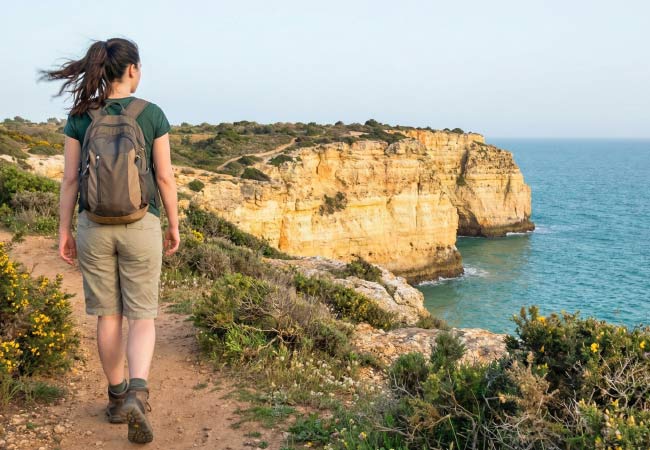
The trail skirts clifftops with views down to hidden coves and beaches
Our most popular guides to the Algarve


About this guide: I am Phil Giddings. I live in Lisbon with my Portuguese wife, Carla, whose family and friends are in the Algarve, and I am down in the Algarve most months to research these guides, which are now my full-time work. I made my first trip to Portugal in 2001 and have written independent guides since 2009.
My Algarve guides are part of a wider set of almost 2,000 I have written across Portugal. No tourist board, tour operator, or attraction pays to be included, and the site is funded by affiliate commissions on tour and accommodation bookings, disclosed on every page that carries them. Every practical detail (ticket prices, opening hours, bus routes, boat-tour policies) is checked against the official sources and confirmed in person on the trips I make through the year. Read my full story here.